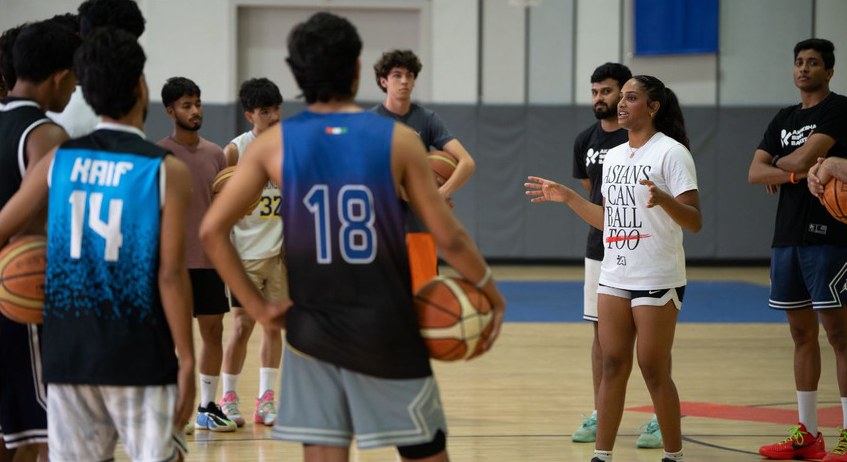
Adyra Rajan spent a day on the court with our athletes recently.
She's a 5'9" combo guard out of Fairmont Prep in California, committed to Harvard. She didn't hand our kids a watered-down clinic. She ran them through her own training: the same drills and standards she holds herself to.
Over the day she worked with everyone, from beginners to summer camp kids to our elite players, adjusting what she taught for each group. One thing she kept coming back to was reps. Get your reps in, respect your time.
With the younger groups she stuck to shooting fundamentals: her own warmup done in full, then form shooting with a goal on every set. With the older ones she built competitive drills (a quick-release drill off the whistle, five-spot shooting for points) and pushed the elite group to make decisions at game speed. Even her most advanced work kept circling back to footwork, balance, and a release you can repeat. You get better by showing up and doing the work, not by looking for shortcuts.
For a lot of our athletes, especially the younger girls, Adyra was proof of something. She's Indian-American, the daughter of parents who immigrated from India, competing on a real path to college basketball. Seeing her there made the idea of elite basketball feel a lot less abstract.
We want our athletes learning from people who've actually walked the path, not just from their coaches. That's a big part of why we do these sessions.
Thanks to Adyra for giving us her time and for the energy she brought. We'll be watching to see where she goes next.
A few things that stuck with us
Fundamentals never stop mattering. Even her advanced work came back to footwork, balance, and a repeatable release.
Reps need a purpose. No mindless shooting; every set has a target.
Train at game speed, so skills hold up against a live defender, not just an empty gym.
Judgment is a skill too: when to attack, when to give it up, when to defend a step behind.
In Conversation With Adyra
How has your experience at ASB been so far: the coaching, the player development approach, the facilities?
The coaching staff here is great. The infrastructure is world-class, and the facilities go really well with the training goals and the program. Athletes have a great environment to grow in here.
How does it feel to be an elite athlete at such a young age, competing at the highest level consistently?
It's really fun, obviously, because I'm in a position I've worked very hard for. Especially being Indian, I think it's something to be very proud of, because there aren't many Indian athletes going to the Division 1 level, especially in women's basketball. So I'm very excited to be part of that small percent, and hopefully spread the word and get more attention on it, so more generations of Indians, boys and girls, can play at that high level.
What are your long-term ambitions in basketball? What do you see as the next step in your journey?
Right now I'm just looking forward to coming into myself as a player and a person in college. My goals are the highest: I want to play as long as I can, whether that's the WNBA or overseas. And my goals go past athletics too. I want to use my Harvard education and make the most of it. It's amazing to have the opportunity to go to a university that has the best of both worlds, so I'm excited to make the most of everything.
What habits, on and off the court, have helped you reach the level you're at today?
The main thing is having an amazing support system. As an athlete, and especially as a young kid, it gets hard. You get tired, there's school, there's a lot to balance. But my parents are amazing, and I have great mentors, family, and friends who keep me consistent and keep my eyes on the prize. When you get bored or exhausted, you think, okay, my future self will thank me for doing this. I do everything with pride, because not a lot of Indians get the opportunity I've gotten to play basketball at this level in the US.